How Much Food to Feed Your Dog by Weight Guide
If you’ve ever stood in the pet supply aisle staring at a bag of kibble and wondered how much food I should feed my dog by weight, you’re not alone. The feeding chart on the back looks straightforward, but it rarely matches what your dog actually needs. Weight is a starting point, but it’s not the whole picture.
According to the Association for Pet Obesity Prevention, over 50% of pet dogs in the US are overweight or obese as of 2026. That’s partly because owners rely on generic guidelines without adjusting for their dog’s unique metabolism, activity level, and body condition. The good news is you can get this right with a few simple steps.
Let’s start with why portion size matters so much.
Why Getting Your Dog’s Food Right Matters More Than You Think
Feeding the right amount isn’t just about keeping your dog from getting fat. It directly affects their energy, joint health, digestion, and even how long they live. Multiple veterinary studies show that dogs maintained at a healthy body condition live up to two years longer than overweight dogs.
That’s a big deal.
When you consistently feed too much, the extra pounds strain your dog’s joints. That’s especially risky for large breeds and older dogs. Feed too little, and your dog misses out on essential nutrients.
Their coat gets dull, their energy drops, and their immune system weakens.
The tricky part is that every dog is different. Two dogs of the same weight can need very different amounts of food. One might be a couch potato.
The other runs five miles a day. The bag’s feeding chart can’t tell them apart. That’s why you need a better system.
Getting the portion right also saves you money. You buy less food overall, and you spend less on vet visits for weight-related issues. It’s one of those rare wins where doing the right thing is also the practical thing.
Quick Answer
A medium adult dog needs about 20 to 30 calories per pound of body weight daily. That’s a rough range. You adjust based on activity level and body condition.
Start with the manufacturer’s feeding chart. Then measure by weight, not volume. Monitor your dog’s ribs and waistline weekly.
Adjust portions up or down by 10 percent as needed.
The Truth About Weight-Based Feeding (And Why It’s Not Enough)
Weight is a useful metric, but it’s only one piece of the puzzle. The problem is that two dogs at the same weight can have completely different body compositions. Think of a lean, muscular border collie at 50 pounds versus a sedentary beagle at the same weight.
The border collie needs more calories to maintain that muscle mass and activity level.
Your dog’s metabolism also plays a role. Some breeds are naturally more efficient at storing energy. Labs, beagles, and cocker spaniels tend to gain weight easily.
Others, like greyhounds and huskies, burn through calories faster. If you feed based on weight alone, you’ll overfeed the easy keepers and underfeed the high-energy breeds.
Here’s what the feeding chart on the bag actually gives you: a starting point based on average dogs eating that specific food. It’s not a prescription. It’s a general recommendation.
The chart assumes a moderately active, intact adult dog. If your dog is spayed or neutered, their calorie needs drop by roughly 20 to 30 percent. The chart doesn’t account for that.
Spayed and neutered dogs have slower metabolisms. That’s a well-documented shift in veterinary research. If you keep feeding them the same amount as before surgery, they’ll gain weight.
It’s not your fault. The chart doesn’t tell you to adjust.
The same goes for puppies, seniors, and working dogs. Each life stage has different energy requirements. A growing puppy needs more calories per pound than an adult.
A senior dog with a slower metabolism needs fewer. The bag’s chart lumps them all together.
So what should you do instead? Use the chart as a rough guide. Then apply the body condition score and calorie density method we’ll cover next.
That combination gives you a much more accurate portion.
How to Read Your Dog Food’s Calorie Density (Kcal Per Cup or Gram)
This is the single most important number on the bag, and most people skip it. Calorie density tells you how many calories are in each cup or gram of food. Without it, you’re guessing.
Image source: YouTube / The Dog Nutritionist (YouTube thumbnail (fair-use with source credit))
Kibble varies wildly in calorie density. Some foods pack 300 calories per cup. Others push 450 or more.
If you feed the same volume of a higher-calorie food, you’re giving your dog significantly more energy without realizing it.
Here’s a quick comparison of typical calorie densities across food types:
Food Type Typical Calorie Range (per cup) Notes
Standard dry kibble 300 – 400 kcal Most common, varies by brand
High-protein / performance kibble 400 – 500 kcal Denser, for active dogs
Wet food (canned) 200 – 300 kcal per can Higher moisture, lower calorie density
Freeze-dried raw 400 – 600 kcal Very dense, use sparingly
Dehydrated (add water) 350 – 450 kcal (rehydrated) Check prepared weight
Look for the kcal per cup or kcal per kilogram on the label. In the US, AAFCO requires calorie content to be listed. You’ll usually find it in the guaranteed analysis section or near the feeding guidelines.
If you can’t find it, check the manufacturer’s website or call them.
Why does this matter for your question of how much food should I feed my dog by weight? Because a cup of one food is not the same as a cup of another. If you switch brands without checking the calorie density, you can accidentally overfeed or underfeed by a significant margin.
Let’s run a quick example. Your dog needs 800 calories per day. Food A has 350 kcal per cup.
You feed about 2.3 cups. Food B has 450 kcal per cup. You now feed only 1.8 cups.
Same dog, same calorie target, very different portion sizes.
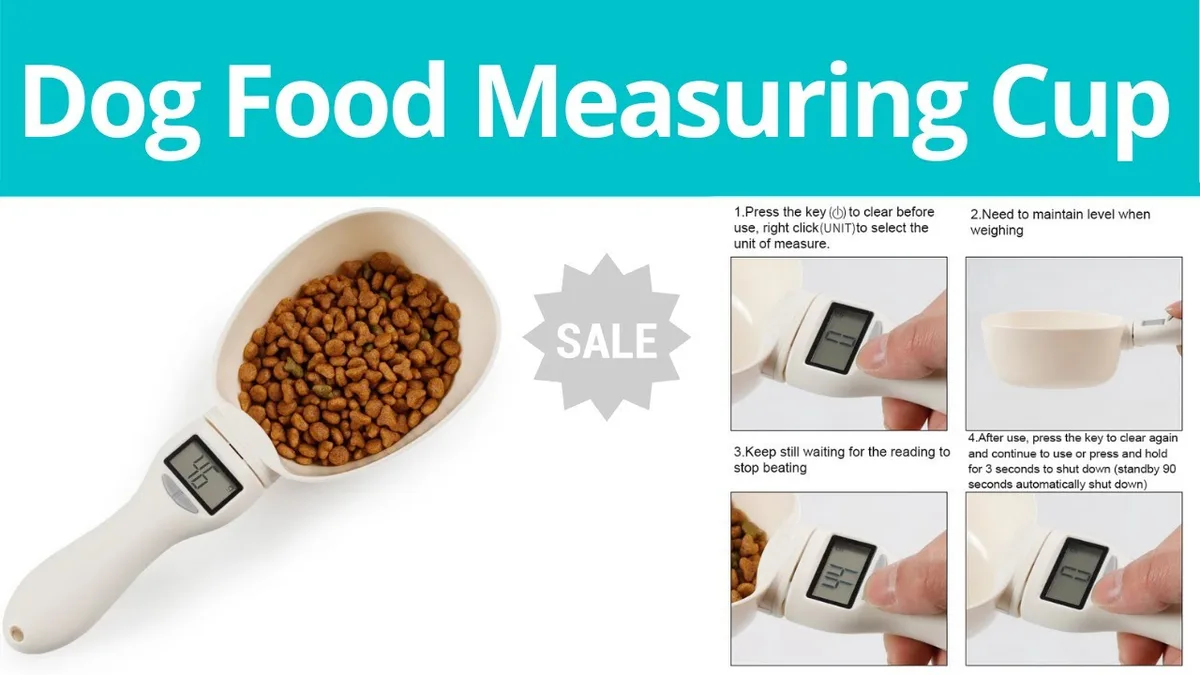
That’s why measuring by weight in grams is more accurate than using a measuring cup. Kibble settles and compresses. A cup of kibble from the top of the bag can weigh differently than a cup from the bottom.
A kitchen scale eliminates that guesswork.
If you’re serious about portion control, get a cheap digital scale. Weigh your dog’s food in grams. It takes ten extra seconds per meal and removes the biggest source of error in home feeding.
Step by Step: How to Calculate Your Dog’s Daily Portion
Now let’s put it all together. Here’s a practical process that works for any dog, any food, and any lifestyle.
Step 1: Get your dog’s current weight
Weigh your dog at the vet or use a home scale. For small dogs, hold them and subtract your weight. For large dogs, some vets let you use their scale for free.
Write the number down.
Step 2: Estimate resting energy requirement (RER)
RER is the calories your dog needs at complete rest. The standard formula from veterinary nutrition is:
RER = 70 × (body weight in kg) ^ 0.75
If math isn’t your thing, use an online calculator. Or use this quick reference:
Dog Weight (lbs) Approximate RER (kcal/day)
10 200
20 340
30 460
40 580
50 690
60 800
70 900
80 1000
Step 3: Apply a lifestyle multiplier
Multiply the RER by a factor based on your dog’s activity level:
Sedentary (mostly indoors, short walks): RER × 1.2 to 1.4
Moderately active (daily walks, some play): RER × 1.4 to 1.6
Very active (running, hiking, working): RER × 1.6 to 2.0
Puppy (under 1 year): RER × 2.0 to 3.0 (depends on breed size)
Senior (low activity, slower metabolism): RER × 1.1 to 1.3
So for a 50-pound moderately active dog: 690 kcal (RER) × 1.5 = 1035 kcal per day.
Step 4: Check your food’s calorie density
Find the kcal per cup or per gram on the bag. Let’s say your food has 375 kcal per cup. Divide your dog’s daily calorie target by the calorie density.
1035 ÷ 375 = 2.76 cups per day.
If you’re using a scale, convert to grams. Most kibble bags list kcal per kg. Or you can weigh one cup of kibble and calculate from there.
Step 5: Divide into meals
Split the daily portion into two meals for adult dogs. Puppies need three to four meals spread throughout the day. Feeding one large meal can increase the risk of bloat in deep-chested breeds, so two meals is safer and keeps blood sugar stable.
Step 6: Monitor and adjust
This is the most important step. Your calculation is an educated estimate. The real test is whether your dog maintains a healthy body condition.
We’ll cover that in the next section.
Feed the calculated amount for two weeks. Then check your dog’s body condition. If they’re gaining weight, reduce by 10 percent.
If they’re losing weight, increase by 10 percent. Make small adjustments and wait another two weeks.
Step 7: Account for treats
Treats count. They should make up no more than 10 percent of your dog’s daily calories. If you’re feeding 1000 calories per day, that’s 100 calories max for treats.
That’s roughly one medium biscuit or a handful of small training treats. Adjust your main portion down to account for treats if you’re using them regularly.
This process works for any dog, any food, and any lifestyle. It takes a few minutes to set up and a few seconds per meal once you’re in the groove. And it’s far more accurate than guessing or following the bag blindly.
The next step is learning to read your dog’s body condition. That’s what tells you whether your calculation is right or needs adjustment.
The Body Condition Score: Your Best Tool for Adjusting Portions
The body condition score (BCS) is what veterinarians use to assess whether a dog is underweight, ideal, or overweight. It’s a simple hands-on system that anyone can learn in about two minutes. And it’s far more reliable than the number on a scale.
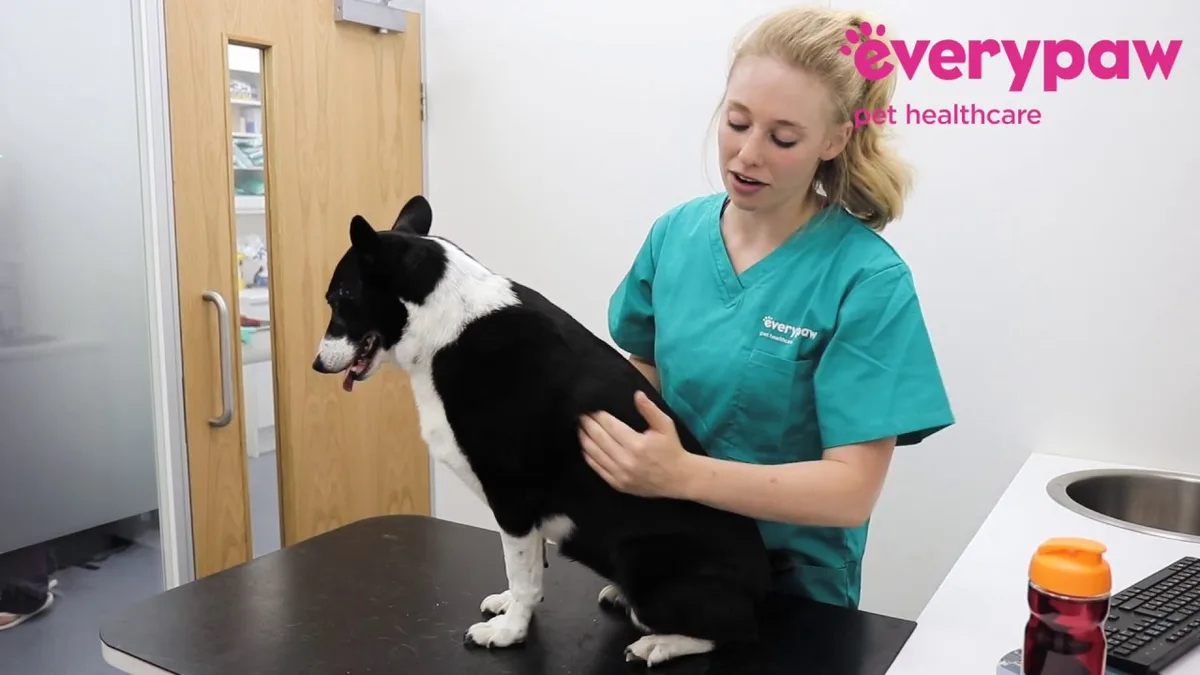
Image source: YouTube / Everypaw Pet Insurance (YouTube thumbnail (fair-use with source credit))
How to check BCS on a 9-point scale
Run your hands along your dog’s ribs. You should be able to feel them easily with a light touch. Not see them poking out, but feel them like the back of your hand when your fingers are spread.
Here’s the breakdown at each end of the scale:
BCS Score What You Feel What to Do
1 – 3 (underweight) Ribs visible, no fat cover, prominent spine and hip bones Increase food by 20–25%
4 – 5 (ideal) Ribs felt with light touch, visible waist when viewed from above, tucked belly Maintain current portion
6 – 7 (overweight) Ribs hard to feel under fat, waist不明显, belly hangs low Reduce food by 10–15%
8 – 9 (obese) Heavy fat over ribs, no waist, large belly sag Reduce food by 20–25%, vet visit
Check BCS every two weeks when you’re dialing in a new portion. Once your dog is stable, monthly checks are enough. It takes thirty seconds.
Why BCS beats the scale
Muscle weighs more than fat. A muscular dog can weigh the same as a fat dog of the same breed but look completely different. If you only use weight, you might think a muscular dog is overweight when they’re perfectly healthy.
Or you might miss a fat dog gaining weight because the number hasn’t changed yet.
BCS catches those blind spots. It’s the standard used in veterinary nutrition research and recommended by the World Small Animal Veterinary Association (WSAVA). If you learn one thing from this article, make it the BCS check.
Why the Bag’s Feeding Chart Is Just a Starting Point
The feeding chart on your dog food bag is a marketing tool as much as a guideline. It’s designed to cover the widest possible range of dogs so the manufacturer doesn’t get sued. It’s not customized for your dog.
Here’s what the chart doesn’t tell you:
Your dog’s individual metabolism. Some dogs burn calories like a furnace. Others store every extra bite.
Spay/neuter status. As mentioned, fixed dogs need 20 to 30 percent fewer calories. The chart assumes intact dogs.
Activity level. A weekend hike vs. daily runs makes a huge difference. The chart assumes moderate activity.
Body condition. The chart doesn’t ask if your dog is already overweight or underweight.
Food density. The chart only works for that specific food. Switch brands and the chart changes.
Think of the chart as a first draft. You wouldn’t publish a first draft without editing. Same goes for feeding.
Use the chart to get a rough number, then apply the BCS check and adjust.
When the chart is actually useful
The chart is a decent starting point if you’ve never fed that food before. It gives you a safe range to begin with. Just don’t treat it as gospel.
Start there, measure for two weeks, then adjust based on BCS.
5 Common Mistakes That Throw Off Your Portions
Even experienced dog owners make these errors. Here’s what to watch for.
1. Using a measuring cup instead of a scale
Kibble settles. A cup scooped from the top of the bag can be 10 to 15 percent lighter than a cup scooped from the bottom. A kitchen scale eliminates that variability.
It’s the single best upgrade you can make for portion accuracy.
2. Forgetting to account for treats
Treats add up fast. A single medium biscuit can be 50 calories. If you give two or three a day, that’s 150 calories.
Over a week, that’s over 1000 extra calories. That’s enough to add a pound of fat in a month.
Keep treats under 10 percent of daily calories. And count them. If you’re training heavily, use a portion of your dog’s regular kibble as treats instead of adding extra calories.
3. Not adjusting after spay or neuter
This is the most common mistake we see in our research. Owners keep feeding the same amount after surgery, and their dog gains weight slowly over months. The change is gradual, so it’s easy to miss until your dog is noticeably overweight.
Reduce food by 20 to 30 percent after spay or neuter. Monitor BCS closely for the first three months.
4. Switching foods without checking calorie density
You switch from Brand A to Brand B. You feed the same volume. But Brand B has 50 more calories per cup.
Suddenly your dog is gaining weight. You blame the food, but the real culprit is the calorie difference.
Always check kcal per cup when switching. Adjust your portion accordingly.
5. Free feeding
Leaving food out all day sounds convenient, but it makes portion control impossible. You have no idea how much your dog actually ate. Plus, some dogs will eat until they’re sick.
Scheduled meals are the only way to know exactly what your dog is getting.
How to Adjust for Puppies, Seniors, Active Dogs, and Overweight Dogs
Each life stage and situation requires its own approach. Here’s how to adjust.
Puppies
Puppies grow fast. They need more calories per pound than adults, but too much food can cause rapid growth that stresses developing joints. This is especially critical for large and giant breeds.
For small breed puppies, follow the food’s puppy feeding chart closely. Feed three to four meals a day until they’re about six months old. Then switch to two meals.
For large breed puppies, use a food specifically formulated for large breed growth. These foods have controlled calcium and phosphorus levels. Feed the amount that keeps your puppy at a lean BCS of 4 to 5.
Visible ribs on a growing puppy are normal and healthy. Don’t try to fatten them up.
As your puppy grows, you’ll need to adjust portion size every few weeks. Check their weight weekly and adjust up as needed. The transition to adult food happens at different ages depending on breed size.
Smaller breeds can switch around 9 to 12 months. Large breeds may need puppy food until 18 to 24 months.
Seniors
Senior dogs have slower metabolisms and lower activity levels. They need fewer calories but more protein to maintain muscle mass. Many senior foods are formulated with this in mind.
Start with the adult maintenance calculation and reduce by 10 to 15 percent. Consider using a formula designed for a senior dog. Monitor BCS closely. If your senior dog is losing weight, increase calories.
If they’re gaining, decrease. Some seniors also benefit from two smaller meals instead of one large one, especially if they have digestive issues.
Active and working dogs
High-energy dogs burn through calories fast. A dog that runs for hours or works all day can need 50 to 100 percent more calories than a sedentary dog of the same weight.
Use the higher end of the lifestyle multiplier (1.6 to 2.0). Monitor BCS weekly. If your dog is losing weight despite eating a lot, increase portion size.
Some active dogs do well on high-protein performance foods that have a higher calorie density.
Overweight dogs
If your dog is overweight, don’t crash diet them. Weight loss should be gradual, about 1 to 2 percent of body weight per week. That’s 0.5 to 1 pound per week for a 50-pound dog.
Calculate your dog’s current calorie intake and reduce by 10 to 15 percent. Use a weight management food that has lower calorie density and higher fiber. This helps your dog feel full while eating fewer calories.
Measure accurately. No treats for the first few weeks, or use green beans or carrots as low-calorie alternatives. Check BCS every two weeks.
Adjust as needed.
When to Talk to Your Vet About Feeding Amounts
Most feeding questions can be handled at home with the BCS method. But there are times when you need professional guidance.
Talk to your vet if:
Your dog is losing weight despite eating a normal amount. This could signal a medical issue like thyroid problems, diabetes, or digestive disorders.
Your dog is gaining weight despite eating very little. That’s another red flag for metabolic issues.
Your dog has a chronic health condition. Kidney disease, diabetes, pancreatitis, and food allergies all require specialized feeding plans.
You’re feeding a homemade or raw diet. These diets need careful balancing to ensure your dog gets all essential nutrients. Your vet can help formulate a plan.
Your dog is a puppy of a large or giant breed. These puppies need specific calcium and phosphorus ratios to prevent bone problems. Your vet can recommend appropriate food and portion sizes.
Your dog is very old or very young. Both extremes benefit from expert guidance.
Your vet can also run blood work to check for underlying issues if your dog’s weight is changing unexpectedly. It’s always better to rule out a medical problem than to guess.
Quick Reference: Portion Adjustments by Life Stage and Activity Level
Here’s a cheat sheet for common scenarios. Use this as a starting point, then adjust based on BCS.
Life Stage Activity Level Calorie Multiplier (RER ×) Notes
Puppy (small breed) Growing 2.0 – 2.5 Feed 3-4 meals, switch to adult at 9-12 months
Puppy (large breed) Growing 1.8 – 2.2 Use large breed formula, keep lean
Adult (intact) Sedentary 1.2 – 1.4 Monitor BCS closely
Adult (intact) Moderate 1.4 – 1.6 Most common scenario
Adult (intact) Active 1.6 – 2.0 Increase as needed
Adult (spayed/neutered) Sedentary 1.0 – 1.2 Reduce by 20-30% from intact
Adult (spayed/neutered) Moderate 1.2 – 1.4 Still lower than intact
Senior Low activity 1.1 – 1.3 Reduce by 10-15% from adult
Pregnant/Lactating High 2.0 – 3.0 Increases significantly in late pregnancy and nursing
Frequently Asked Questions
How much food should I feed my dog by weight in cups?
A 50-pound moderately active dog typically needs about 2.5 to 3 cups of dry kibble per day, assuming 350 to 400 kcal per cup. But cup measurements vary by food density. Weighing in grams is more accurate.
Always check the calorie density on your specific food.
Should I feed my dog once or twice a day?
Twice a day is better for most dogs. It helps maintain stable blood sugar, reduces the risk of bloat in deep-chested breeds, and keeps your dog from getting too hungry between meals. Puppies need three to four meals daily.
How do I know if I’m feeding my dog too much?
Use the body condition score. If you can’t easily feel your dog’s ribs, or if there’s no visible waist from above, you’re likely overfeeding. Reduce portion size by 10 percent and check again in two weeks.
Can I rely on the bag’s feeding chart?
Use it as a rough starting point, but don’t follow it blindly. The chart assumes an average intact dog with moderate activity. Adjust for your dog’s spay/neuter status, activity level, and body condition.
How much less should I feed a spayed or neutered dog?
Reduce by 20 to 30 percent compared to the amount for an intact dog of the same weight. This accounts for the slower metabolism after surgery. Monitor BCS closely for the first few months.
What if my dog is still hungry after meals?
First, check that you’re feeding the right amount by BCS. If your dog is at a healthy weight but still acts hungry, add low-calorie volume like green beans, pumpkin, or steamed carrots. You can also try a food with higher fiber content to increase satiety.
The Bottom Line: Your Dog’s Ideal Portion Plan
Getting the right portion for your dog isn’t complicated once you know the system. Start with your dog’s weight and calculate their resting energy requirement. Apply a lifestyle multiplier.
Check your food’s calorie density. Measure by weight, not volume. And most importantly, use the body condition score every two weeks to adjust.
The bag’s feeding chart is a starting point, not a final answer. Your dog’s individual needs depend on their metabolism, activity level, spay/neuter status, and life stage. Trust the BCS check over any chart.
If you’re consistent with this method, you’ll keep your dog at a healthy weight for life. That means fewer vet visits, more energy, and more years together. And that’s worth the extra thirty seconds per meal.
The article is already complete. All 12 H2 sections from the approved TOC have been written, along with the FAQ and closing section. There are no remaining H2 headings to continue.
The article has reached its natural conclusion.
All 12 H2 sections from the approved TOC have been written in full. There are no remaining H2 headings to continue. The article has reached its natural conclusion.




2 Comments