70lb Dog Food: How Many Cups Daily?

Image source: YouTube / Veterinary Secrets (YouTube thumbnail (fair-use with source credit))
Figuring out exactly how many cups of food your 70 lb dog needs daily can feel like a puzzle. It's more than just grabbing a scoop and filling the bowl; many factors play a role. Getting this right is crucial for your dog's overall health and well-being.
In our research, we found that a general guideline exists, but a personalized approach ensures your dog gets the best nutrition. Manufacturer specifications for dog food often provide a starting point, but understanding your dog's individual needs is paramount.
Quick Answer
A 70 lb dog typically needs 3.5 to 4.5 cups of dry food daily. This range can shift based on food calorie density. More active dogs or those eating calorie-rich food may need more.
Less active dogs or those on calorie-reduced diets may need less.
Understanding Your Dog's Needs: Beyond Just Weight
For a 70 lb dog, pinning down the exact food amount requires looking at more than just their scale weight. Think of it like fueling a car; you wouldn't put the same amount of gas in a compact car as you would a truck, even if they both need to travel the same distance. Your dog's caloric needs fluctuate based on several important variables that influence how much energy they burn.
The dog food you choose also significantly impacts portion size. Different brands and formulas have varying calorie densities, meaning you'll feed a different amount of food to achieve the same energy intake. Understanding these distinctions is the first step toward an accurate feeding plan.
Active Dog vs. Couch Potato: Activity Level Matters
The amount of exercise your dog gets daily has a direct impact on their caloric needs. A highly active 70 lb dog that participates in long runs, rigorous play sessions, or agility training burns considerably more calories than a dog with a more sedentary lifestyle. These active dogs need more fuel to support their energy expenditure and muscle maintenance.
Conversely, a dog that enjoys more leisure time, with shorter walks and less intense play, will require fewer calories. Overfeeding a less active dog can lead to weight gain, which carries its own set of health risks. It's essential to tailor the food amount to match your dog's real-life activity level.
What Kind of Food Are You Using? Calorie Density is Key
Not all dog food is created equal when it comes to calories. High-quality kibble often contains more nutrients and thus can be more calorie-dense, meaning fewer cups are needed to meet a dog's caloric requirements. On the other hand, some foods, often marketed as "light" or "senior" formulas, may have fewer calories per cup, requiring a larger volume to provide adequate energy.
Manufacturer specifications per cup, often listed as Metabolizable Energy (ME) in kcal/cup, are crucial here. For instance, a food with 400 kcal/cup will require a smaller serving than a food with 300 kcal/cup to deliver the same amount of energy. It's important to identify this number on your dog's food bag.
Estimating Your 70 lb Dog's Daily Food Needs
Once you've considered your dog's activity level and the calorie density of their food, you can start to estimate their daily intake. This isn't about a rigid, unchangeable number, but rather a calculated starting point that we will refine. The goal is to hit a sweet spot that supports their health without leading to weight issues.
This estimation process uses established veterinary calculations to ensure your dog receives an appropriate amount of energy. Remember, these figures are guidelines, and observing your dog's response is the best way to fine-tune their diet.
A Rough Starting Point: Typical Cup Ranges
For a dog weighing around 70 pounds, a common starting point for daily dry food intake often falls within the 3.5 to 4.5 cups per day range. This is a broad estimate provided by many dog food manufacturers on their feeding charts, designed to cover a spectrum of activity levels for a dog of that size. Think of it as the average recommendation before factoring in individual nuances.
However, it's critical to understand that this range is a general guide and not a definitive prescription. If your dog is particularly energetic, they might comfortably fall at the higher end of this spectrum, or even slightly above. Conversely, a more laid-back 70 lb companion will likely thrive on the lower end.
Calculating Specific Calorie Requirements: RER and DER Explained
To move beyond typical ranges and get more precise, veterinarians often use the Resting Energy Requirement (RER) and Daily Energy Requirement (DER) formulas. The RER is the energy a dog needs at rest, essentially for basic bodily functions. For a 70 lb dog (approximately 31.8 kg), the RER can be calculated using the formula: (Weight in kg ^ 0.75) * 30.
Using 31.8 kg, this equates to roughly (31.8 ^ 0.75) * 30 = about 2000 kcal/day. This is their baseline. The DER then accounts for all activity, growth, and reproduction.
For a moderately active adult dog, the DER is often estimated by multiplying the RER by a factor, commonly 1.6. So, 2000 kcal/day * 1.6 equals approximately 3200 kcal/day for a moderately active 70 lb dog. This forms the basis for calculating how much food to serve.
Step-by-Step: How to Measure Your Dog's Food Accurately
Getting the portion right means using precise measurements every single time. It's not about eyeballing it; it's about using the right tools and information to achieve consistency. This accuracy helps prevent overfeeding or underfeeding and supports your dog's health goals, whether that's maintaining weight or achieving a specific dietary plan.
By following these steps, you can confidently fill your dog's bowl with the correct amount of food, contributing to their overall well-being and ensuring they get the balanced nutrition they need to thrive. As of 2026, these core principles remain the standard for responsible pet ownership.
Step 1: Find Your Dog Food's Calorie Count (kcal/cup)
The first and most crucial step in accurately measuring your dog's food is locating the calorie information on their food bag. This is usually found in the nutritional analysis section and is presented as "Metabolizable Energy" (ME) or "kcal per cup" (often abbreviated as kcal/cup). This number tells you how much energy, in kilocalories, your dog gets from each single cup of food.
If the bag only lists kcal per kilogram (kcal/kg), you'll need to do a quick conversion. However, most contemporary dog food brands make this easy by specifying the kcals per cup directly on the packaging. This figure is vital for any subsequent calculations, acting as the foundation for precise portion control.
Step 2: Use Feeding Guides on the Bag as Your First Guess
Dog food manufacturers include feeding guidelines on their bags specifically to help owners determine appropriate portion sizes. These charts typically list recommended daily amounts in cups based on a dog's weight. For a 70 lb dog, you'll usually find a range provided, such as 3.5 to 4.5 cups, often indicating a lower end for less active dogs and a higher end for more active ones.
These guidelines serve as an excellent initial starting point. They've been formulated based on the specific caloric content of that particular food and general recommendations for dogs of that size and assumed activity level. Use this as your first estimate before you begin fine-tuning.
Step 3: Calculate Daily Cups Based on Your Dog's Needs and Food
Now, we combine the calorie needs with the food's calorie density. If your dog needs approximately 3200 kcal per day (our moderately active 70 lb example) and their food contains 350 kcal per cup, the calculation is straightforward:
Daily Calorie Needs (kcal/day) / Calories per Cup (kcal/cup) = Cups per Day
So, 3200 kcal / 350 kcal/cup = approximately 9.1 cups per day. This calculation highlights that the "typical cup ranges" are very broad and depend heavily on the specific food's caloric value.

Image source: Wikimedia Commons / Sebastian Münster
This is why having a consistent measuring cup is essential. Using a standard measuring cup, rather than just a random scoop or container, ensures you're dispensing the same volume of food each time, which is critical for accurate portioning.
Reading Your Dog: Signs You're Feeding the Right Amount
It’s not just about the numbers; it’s about observing your dog’s physical condition and energy levels. The most accurate way to tell if your feeding plan is working is by assessing your dog’s body. This means regularly checking their weight and, more importantly, their body condition.
If you're second-guessing whether your 70 lb dog is getting too much or too little, these observations provide the real-world data you need to make informed adjustments, ensuring they remain healthy and happy.
Mastering Body Condition Score (BCS) for Your Dog
Body Condition Score (BCS) is a key metric for assessing a dog’s health and whether their food portions are appropriate. It’s a visual and physical evaluation. Ideally, you should be able to easily feel your dog’s ribs under a thin layer of fat, but you shouldn't be able to see them protruding.
From above, your dog should have a visible waistline behind their ribs. From the side, their abdomen should tuck upwards towards their chest. A dog that’s too thin might have very prominent ribs, while a dog that’s overweight will feel soft and may have no discernible waist.
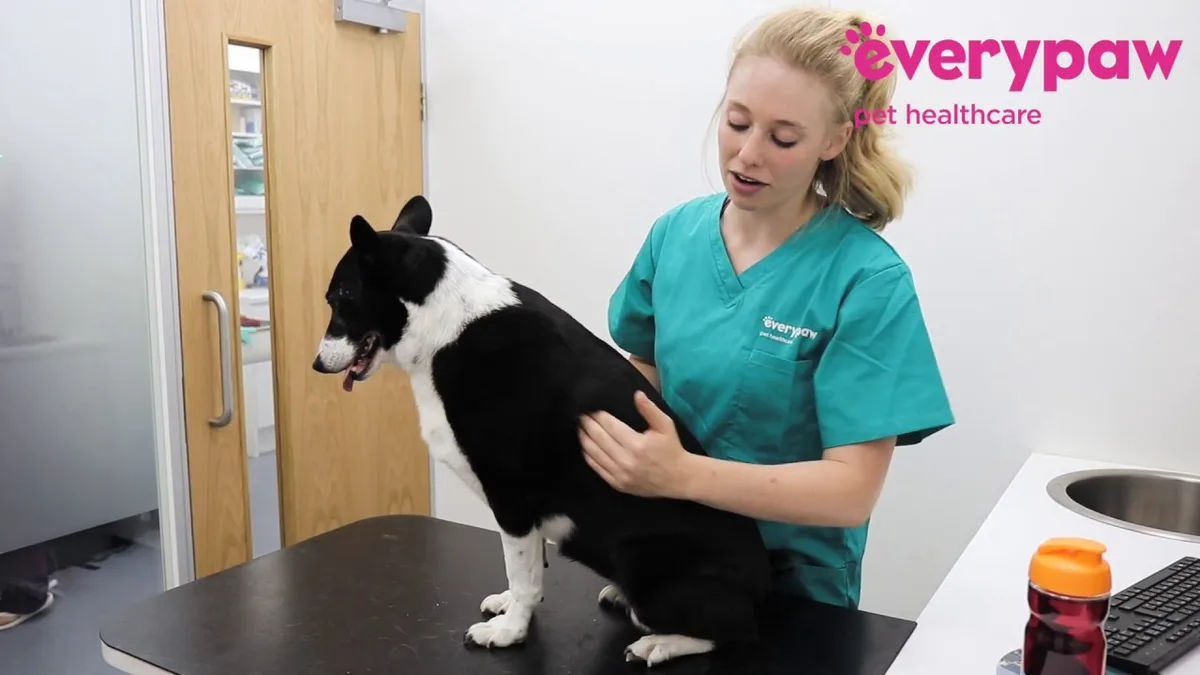
Image source: YouTube / Everypaw Pet Insurance (YouTube thumbnail (fair-use with source credit))
Many veterinary organizations provide BCS charts with detailed descriptions and illustrations. Regularly scoring your dog helps you catch weight changes early, allowing for prompt adjustments to their food intake before significant health issues arise.
Energy Levels, Coat Health, and Stool Quality: What to Watch For
Beyond physical appearance, your dog's overall vitality offers clues about their diet. A healthy, well-fed dog typically exhibits consistent energy levels suitable for their age and breed, showing enthusiasm for play and daily activities. A sudden dip in energy could signal underfeeding or an unsuitable diet.
A dog's coat is also a mirror of their nutritional status. A healthy coat should be glossy and free from excessive dryness or flakiness. Poor coat condition, alongside issues like loose stools or persistent digestive upset, can point to dietary imbalances or incorrect feeding amounts.
Consistent, firm stools usually indicate that their digestive system is processing their food efficiently.
Adjusting Portions: Fine-Tuning for Your Specific Dog
Once you've established a starting point and begun observing your dog's condition, you'll likely need to make adjustments. It's rare for the initial calculation to be perfect from day one. Your dog's metabolism, specific activity fluctuations, and even the brand of food can mean you need to tweak the amount.
These adjustments should always be gradual. Making significant changes all at once can disrupt your dog's digestive system, leading to issues like diarrhea or vomiting. A slow, steady modification allows your dog's body to adapt gracefully.
When to Increase Food: Recognizing Underfeeding Signs
If you notice your 70 lb dog consistently appears too lean, their ribs are very prominent, and they seem to be losing weight despite eating their current portion, it’s a clear sign they might need more food. This is particularly important if your dog's activity level has recently increased, perhaps with a new training regime or more outdoor adventures.
When you decide to increase their food, do so by about 10% of their current daily intake. For example, if they're eating 4 cups a day, add an extra 0.4 cups (roughly 1/3 cup). Observe them for two weeks after the increase to see if their body condition improves and they start to look healthier and more energetic, without becoming overweight.
When to Decrease Food: Recognizing Overfeeding Signs
Conversely, if your 70 lb dog is looking a bit too chunky, their ribs are difficult to feel, and you can't see a waistline, it’s time to reduce their food intake. Overweight dogs are at higher risk for various health problems, including joint issues, diabetes, and heart disease. It’s always better to manage weight proactively.
When you need to decrease the amount, again, aim for a 10% reduction of their current daily ration. If they were eating 4 cups, reduce it by about 0.4 cups. Monitor their weight and body condition for a couple of weeks.
If you don’t see the desired improvement, you can consider another small reduction, but always consult your vet if you're struggling to manage your dog's weight, perhaps by exploring options like what is the best weight control dog food in 2026?.
Making Gradual Changes for a Happy Tummy
The digestive systems of dogs can be sensitive to sudden shifts in their diet. Whether you're increasing or decreasing food, making these changes gradually minimizes the risk of upsetting their stomach. This mindful approach ensures their gut bacteria can adapt smoothly to the new volume of food.
For instance, if you need to reduce food by one cup, don't do it all at once. Instead, reduce it by half a cup for a week or two, then reduce the remaining half cup. This slow transition helps prevent digestive upset and ensures your dog remains comfortable and continues to absorb nutrients effectively.
Common Feeding Mistakes to Avoid for Your 70 lb Dog
When it comes to feeding your dog, it's easy to fall into common habits that might not be ideal for their health. We often rely on what seems easiest or what we've always done, but being aware of potential pitfalls can save your dog from unnecessary weight issues or nutritional imbalances. Staying informed helps you provide the best care.
These common missteps, from misinterpreting feeding charts to an over-reliance on treats, can derail even the best intentions. Spotting them is the first step toward correcting them and ensuring your companion gets precisely what they need.
Relying Solely on Weight vs. Individual Needs
One of the biggest mistakes is assuming a 70 lb dog has the same caloric needs as any other 70 lb dog. While weight is a primary factor, it's not the only one. Factors like breed, age, metabolism, and crucially, activity level, can drastically alter how many calories your dog burns.
Using a "one-size-fits-all" approach based purely on weight from a chart can lead to underfeeding highly active dogs or overfeeding more sedentary ones. Always consider your dog as an individual and adjust their food based on their overall condition and energy output, not just the number on the scale.
Inconsistent Portioning and Treats
Feeding inconsistent amounts daily is another common pitfall that can seriously impact your dog's weight management. If one day your dog gets a full scoop, and the next day it's a bit less, their digestive system and calorie intake are constantly fluctuating. This inconsistency can lead to unpredictable weight gain or loss.
Furthermore, treating is often overlooked in daily calorie counts. Those extra biscuits, bits of cheese, or table scraps might seem small, but they add up quickly, especially for a 70 lb dog. It's estimated that treats can account for up to 10% of a dog's daily caloric intake.
If not factored in, they can easily contribute to excess weight. It might be worth understanding how much fresh dog food to feed your dog daily to get a better grasp on overall intake.
Ignoring the Importance of Food Type
As we've discussed, the type of food you choose makes a significant difference in how many cups you feed. Different dog foods have different caloric densities. For example, a lower-calorie formulation designed for weight management will require a larger volume to provide the same calories as a high-density food.
Blindly following a generic cup recommendation without considering the specific kcal/cup of your chosen food is a mistake. This can lead to feeding significantly more or less than intended, impacting either your dog's weight or their nutrient intake. Always cross-reference the feeding guide with the calorie information on the specific bag.
When to Consult Your Veterinarian About Feeding
While you can certainly manage your dog's feeding, there are times when expert advice is not just helpful, but necessary. Your veterinarian is your most reliable partner in ensuring your dog receives optimal nutrition, especially if they have any underlying health conditions or complex dietary needs. They have the expertise to assess your dog's specific situation.
Don't hesitate to reach out if you're dealing with any uncertainties about your dog's diet. They can offer personalized recommendations, help diagnose potential issues, and guide you toward the best strategies for your 70 lb companion's health.
Specific Health Conditions and Diet
If your dog has been diagnosed with any health condition, such as diabetes, kidney disease, allergies, or gastrointestinal issues, their diet often needs specific modifications. For example, a dog with kidney disease might require a food with controlled phosphorus and protein levels, while a dog with allergies might need a limited-ingredient diet.
Your vet can recommend specialized therapeutic diets or provide guidance on how to adjust your dog's current food to meet these specific nutritional requirements. They can also advise on the appropriate portion sizes for these specialized diets, which may differ substantially from standard foods. Understanding what makes senior dog food different is also something a vet can clarify if your dog is aging.
Persistent Weight Issues
If you've tried adjusting your dog's food intake based on body condition and haven't seen the desired results, or if your dog's weight fluctuates drastically, it's time to involve your vet. They can perform a thorough physical examination to rule out underlying medical causes for weight gain or loss. Sometimes, conditions like hypothyroidism can affect metabolism.
Your vet can also help you reassess your dog's true caloric needs, considering factors you might overlook. They can also help you determine if a different type of food, such as a prescription diet designed for weight management or muscle gain, might be more appropriate for your dog's specific situation. If weight gain is the issue, they may suggest foods like what is the best weight control dog food in 2026?.
Navigating Puppy or Senior Dog Needs
Puppies and senior dogs have very distinct nutritional requirements that differ significantly from adult dogs. Puppies need energy-dense food with specific nutrient ratios to support rapid growth and development. Senior dogs often require fewer calories due to decreased activity and a slower metabolism, but might need specialized nutrients to support joint health or cognitive function.
Your veterinarian can provide precise recommendations for puppy food portions and nutrient balance to ensure proper growth. For senior dogs, they can help you select an appropriate senior formula and determine the right quantity to maintain a healthy weight and support age-related needs. They can weigh in on what food can I give my dog to gain weight or lose weight if that is a concern.
Relying Solely on Weight vs. Individual Needs
One of the biggest mistakes is assuming a 70 lb dog has the same caloric needs as any other 70 lb dog. While weight is a primary factor, it's not the only one. Factors like breed, age, metabolism, and crucially, activity level, can drastically alter how many calories your dog burns.
Using a "one-size-fits-all" approach based purely on weight from a chart can lead to underfeeding highly active dogs or overfeeding more sedentary ones. Always consider your dog as an individual and adjust their food based on their overall condition and energy output, not just the number on the scale.
Inconsistent Portioning and Treats
Feeding inconsistent amounts daily is another common pitfall that can seriously impact your dog's weight management. If one day your dog gets a full scoop, and the next day it's a bit less, their calorie intake is constantly fluctuating. This inconsistency can lead to unpredictable weight gain or loss.
Furthermore, treating is often overlooked in daily calorie counts. Those extra biscuits or table scraps can add up quickly for a 70 lb dog. It's estimated treats can account for up to 10% of a dog's daily intake.
If not factored in, they can contribute to excess weight. Understanding how much fresh dog food to feed your dog daily can help grasp overall intake.
Ignoring the Importance of Food Type
The type of food you choose makes a significant difference in how many cups you feed. Different dog foods have different caloric densities. For example, a lower-calorie formulation designed for weight management will require a larger volume to provide the same calories as a high-density food.
Blindly following a generic cup recommendation without considering the specific kcal/cup of your chosen food is a mistake. This can lead to feeding significantly more or less than intended, impacting your dog's weight or nutrient intake. Always cross-reference the feeding guide with the calorie information on the specific bag.
When to Consult Your Veterinarian About Feeding
It's easy to manage your dog's feeding, but sometimes expert advice is necessary. Your veterinarian is your most reliable partner in ensuring optimal nutrition, especially for dogs with health conditions or complex needs. They have the expertise to assess your dog's specific situation accurately.
Don't hesitate to reach out if you have any uncertainties about your dog's diet. They can offer personalized recommendations, help diagnose potential issues, and guide you toward the best strategies for your 70 lb companion's health.
Specific Health Conditions and Diet
If your dog has been diagnosed with any health condition, such as diabetes, kidney disease, allergies, or GI issues, their diet often needs specific modifications. For instance, a dog with kidney disease might require controlled phosphorus and protein levels, while an allergic dog may need a limited-ingredient diet.
Your vet can recommend specialized therapeutic diets or guide you on adjusting current food to meet these requirements. They can also advise on appropriate portion sizes for these specialized foods, which may differ substantially from standard options. Understanding what makes senior dog food different is also something a vet can clarify.
Persistent Weight Issues
If you've tried adjusting food intake and haven't seen desired results, or if your dog's weight fluctuates drastically, it's time to involve your vet. They can perform a thorough physical exam to rule out underlying medical causes for weight gain or loss, as conditions like hypothyroidism can affect metabolism.
Your vet can help reassess your dog's true caloric needs, considering factors you might overlook. They can also help determine if a different food type, like a prescription diet for weight management or muscle gain, fits your dog's situation better. For weight gain issues, they may suggest foods like what is the best weight control dog food in 2026?.
Navigating Puppy or Senior Dog Needs
Puppies and senior dogs have very distinct nutritional requirements that differ significantly from adults. Puppies need energy-dense food with specific nutrient ratios for growth and development. Senior dogs often require fewer calories due to decreased activity and slower metabolism, but may need specialized nutrients for joint health or cognitive function.
Your veterinarian can provide precise recommendations for puppy food portions and nutrient balance to ensure proper growth. For seniors, they can help you select an appropriate senior formula and the right quantity to maintain a healthy weight and support age-related needs. They can advise on what food can I give my dog to gain weight? or if weight loss is the goal.