
Guide to How Much Raw Food to Feed Dog
Figuring out how much raw food to feed dog can feel like guesswork, especially when every chart you find says something different. Feed too little and your dog loses weight and muscle. Feed too much and you're looking at digestive upset or obesity.
The truth is there's no single number that works for every dog.
In our research, we found that most adult dogs need roughly 2% to 3% of their ideal body weight in raw food per day. That range comes from calorie calculations, not just scoops. The National Research Council's nutrient guidelines and the World Small Animal Veterinary Association both stress that portion size must match your dog's individual energy needs.
So how do you find your dog's number? Let's walk through it.
Quick Answer
Most adult dogs need 2% to 3% of their ideal body weight in raw food daily. A 50-pound dog gets roughly 1 to 1.5 pounds per day. Puppies need 5% to 10% of body weight.
Split that into two or three meals. Always check body condition and adjust.
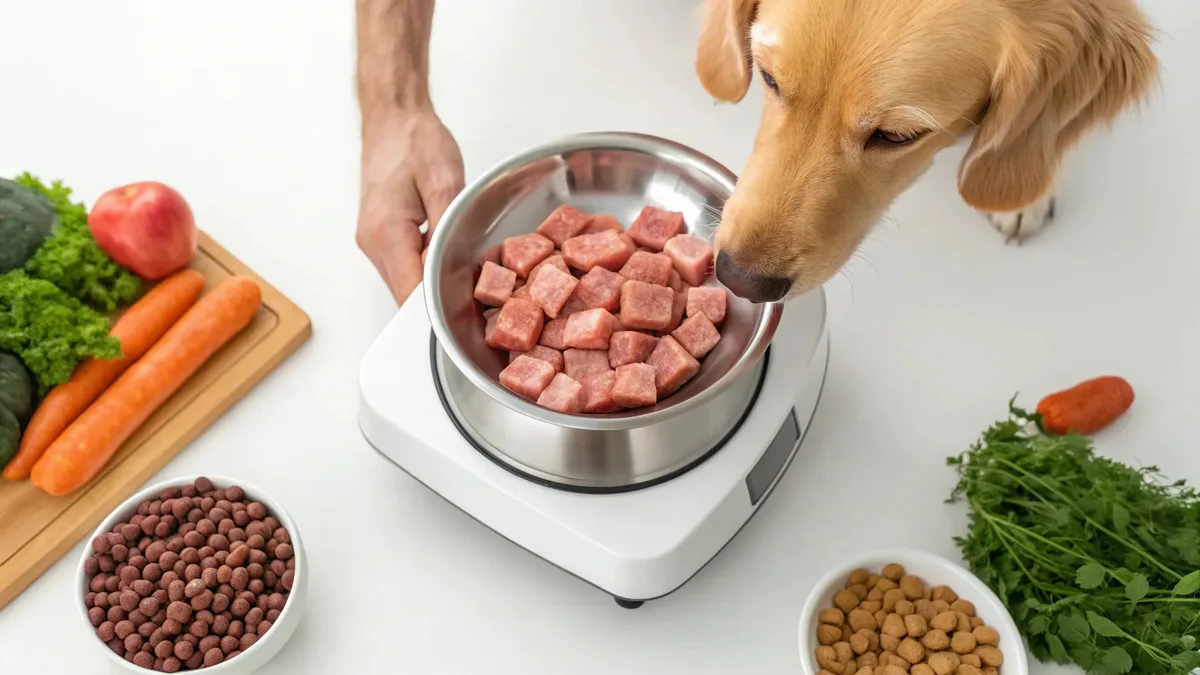
Image source: Web (Bing) / houndsy.com (Web image (fair-use with source credit))
Why Raw Food Portions Matter More Than Most Owners Realize
Getting the portion wrong isn't a minor issue. It's one of the fastest ways to make your dog sick. In our research, we've seen that both overfeeding and underfeeding raw food lead to real health problems.
Over time, those problems can become serious.
What Happens When You Guess
If you guess, you might feed too much fat and protein. That can trigger pancreatitis in sensitive dogs. Or you might underfeed, which causes muscle loss and low energy.
Puppies are especially at risk. A growing dog needs precise calcium and phosphorus levels. Guessing can lead to skeletal deformities.
Why One-Size-Fits-All Charts Fail
Most feeding charts assume a fixed percentage of body weight. But your dog's needs change with age, activity, and health. A couch potato Labrador needs far less than a working Collie of the same weight.
A dog with kidney disease needs a different protein level entirely. That's why the World Small Animal Veterinary Association recommends regular nutritional assessments. You can't rely on a single number forever.
If you've ever struggled with a picky eater, you know how stressful mealtime can be. Sometimes the issue isn't the amount but the food itself. Our guide on getting a dog to eat covers practical tricks that pair well with portion adjustments.
The Core Formula: Calories, Body Condition, and the 2 to 3% Rule
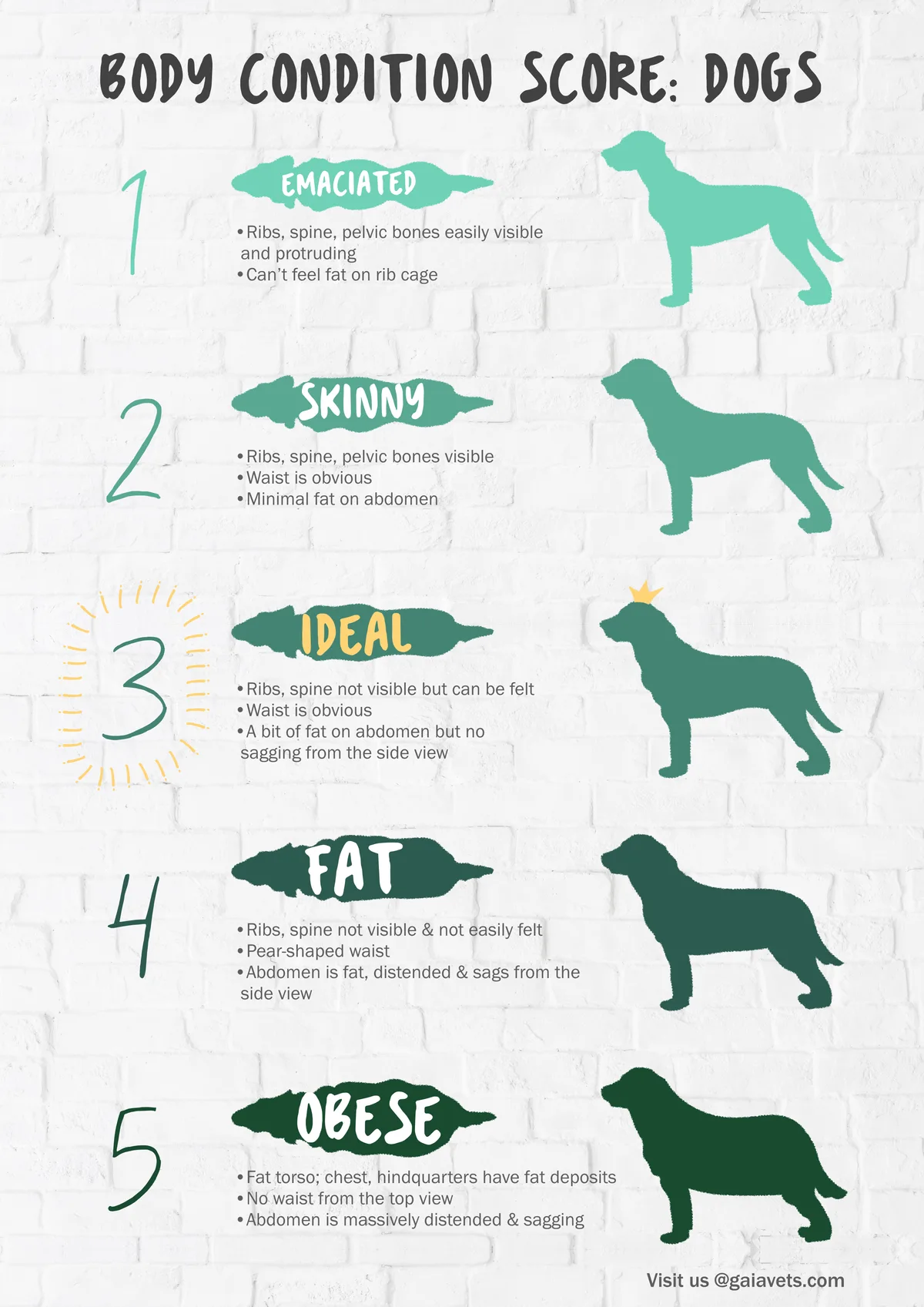
Image source: Web (Bing) / gaiavets.com (Web image (fair-use with source credit))
You need two things to find the right amount: calories and body condition. Calories tell you how much energy your dog needs. Body condition tells you if that energy is too much or too little.
Resting Energy Requirement (RER) and Maintenance Energy (MER)
RER is the calories your dog burns at rest. The formula is 70 times (body weight in kg) to the 0.75 power. Multiply RER by a factor to get MER, your dog's daily need.
| Life Stage / Activity | MER Factor |
|---|---|
| Weight loss | 1.0 to 1.2 |
| Neutered adult | 1.6 |
| Intact adult | 1.8 |
| Active adult | 2.0 to 3.0 |
| Puppy (under 4 months) | 3.0 |
| Lactating | 4.0 to 6.0 |
The World Small Animal Veterinary Association publishes global nutrition guidelines that explain these factors in detail. Use them as a starting point, not a final answer.
Body Condition Score: The Best On-Dog Gauge
Body condition score (BCS) is a 1 to 9 scale. You feel your dog's ribs, spine, and hips. A score of 4 or 5 is ideal.
You should feel ribs easily but not see them.
If you see ribs, your dog is too thin. If you can't feel ribs, your dog is overweight. Adjust food up or down based on BCS, not just the scale.
The 2 to 3% Rule and When to Adjust It
The 2 to 3% rule is a shortcut. Feed 2% of body weight for weight loss or less active dogs. Feed 3% for active dogs.
But always confirm with BCS. If your dog gains weight on 3%, drop to 2.5%. If they lose weight, increase.
This rule works best for adult dogs at maintenance.
How to Calculate Your Dog's Daily Raw Food Amount Step by Step
Here's the process we recommend. It takes five steps. Do them in order.
Step 1: Weigh Your Dog and Score Body Condition
Use a scale. If you can't weigh your dog, weigh yourself holding your dog, then subtract your weight. Score BCS.
Write down both numbers.
Step 2: Find Daily Calories
Calculate RER. Multiply by the MER factor from the table above. For a 50-pound (22.7 kg) neutered adult: RER = 70 x (22.7)^0.75 ≈ 70 x 10.4 = 728 kcal.
MER = 728 x 1.6 = 1,165 kcal per day.
Step 3: Convert Calories to Raw Food Weight
Check your raw food's calorie content. Most raw diets have about 1.5 to 2 kcal per gram. Divide total calories by kcal per gram.
For 1,165 kcal at 1.8 kcal/g: 1,165 / 1.8 ≈ 647 grams per day. That's about 1.4 pounds.
Step 4: Split Into Meals and Track Results
Puppies need 3 to 4 meals daily. Adults do fine with 1 or 2. Split the total grams evenly.
Track your dog's weight and stool quality for two weeks. If stools are loose, reduce the amount slightly. If your dog has a sensitive stomach, transition slowly.
Step 5: Recheck and Adjust Every 2 to 4 Weeks
Weigh your dog. Score BCS again. If weight is stable and BCS is 4 or 5, keep the same amount.
If not, adjust by 10% up or down. Small changes add up.
When the Amount Changes: Puppies, Seniors, Activity, and Health Conditions
Image source: Web (Bing) / barkleysbag.com (Web image (fair-use with source credit))
Your dog's daily amount isn't fixed forever. It changes with life stage, activity, and health. Here's how to adjust.
Puppies and Growing Dogs
Puppies need 5% to 10% of body weight in raw food daily. Split that into 3 or 4 meals. They burn a lot of energy.
But they also need precise calcium and phosphorus. Too much or too little can cause bone problems. For general puppy feeding advice, see our guide on puppy feeding basics.
Seniors and Less Active Dogs
Senior dogs usually need fewer calories. Start with 1.5% to 2% of body weight. Watch for weight gain.
Older dogs also lose muscle mass. Keep protein high but reduce fat if they're inactive.
Working, Sporting, and Pregnant or Lactating Dogs
Working dogs can need 3% to 4% or more. Sled dogs and herding dogs burn thousands of calories daily. Pregnant dogs need 1.5 times normal in early pregnancy, up to 3 times normal by the end.
Lactating dogs need even more, sometimes 4 to 6 times maintenance.
Dogs With Allergies, Pancreatitis, Kidney Disease, or Obesity
Health conditions change everything. Allergies may need a novel protein. Pancreatitis needs a low-fat recipe.
Kidney disease needs restricted protein and phosphorus.
Our article on kidney-friendly options explains more. Obesity needs a weight-loss portion, usually 1.0 to 1.2 times RER. Always work with your vet for these conditions.
Raw Feeding Safety and Nutrient Balance: Risks You Can't Ignore
Raw feeding has real risks. You're handling raw meat. You're also balancing nutrients.
Get either wrong and your dog can get sick.
Pathogens: Salmonella, Listeria, E. coli, and Parasites
Raw meat can carry dangerous bacteria. The CDC warns that these germs can make your dog sick and spread to your family.
Wash your hands after handling. Sanitize counters and bowls. Freeze meat at 0°F (-18°C) for at least 24 hours to kill some parasites.
But freezing doesn't kill all bacteria. The CDC raw pet food page has detailed safety steps.
Bone Safety and Digestive Risks
Never feed cooked bones. They splinter and can perforate the gut. Raw bones are safer but still risky.
Choose size-appropriate bones. Avoid weight-bearing bones from large animals. Watch for choking or broken teeth.
Ground bone is a safer option for many dogs.
Complete vs Complementary Raw Diets
A complete raw diet meets AAFCO or FEDIAF nutrient profiles. A complementary diet does not. Complementary diets need supplements to be balanced.
If you're making food at home, use a meal completer. Or work with a board-certified veterinary nutritionist.
Calcium, Phosphorus, Organ Meat, and Supplement Balance
The calcium to phosphorus ratio should be 1.2:1 to 1.4:1. Organ meat should be 10% of the diet. That's 5% liver and 5% other secreting organs.
Too much liver can cause vitamin A toxicity. Too little can cause deficiencies. If you feed human foods as treats, check our safe human food list first.
Common Portioning Mistakes and When to Get Veterinary Help
Even careful owners slip up. In our research, the same mistakes show up again and again. Here are the big ones and how to catch them.
Overfeeding, Underfeeding, and Misreading Body Condition
Overfeeding is the most common error. Owners eyeball portions instead of weighing them. A gram scale removes the guesswork in seconds.
Underfeeding often hides behind picky eating. If your dog walks away from the bowl, the amount might be too large for one sitting. Some dogs also need a different texture or flavor before they'll finish a meal.
Misreading BCS is sneaky. Long-haired dogs hide their ribs. Fluffy breeds can look chunky when they're lean, and lean when they're not.
Thawing, Storage, and Cross-Contamination Mistakes
Thaw raw food in the fridge, never on the counter. Room temperature is a breeding ground for bacteria. Give it 24 to 48 hours to defrost safely.
Never refreeze thawed raw food. Discard anything left out over two hours. Use separate cutting boards for raw meat, and wash bowls after every meal.
Red Flags That Need a Vet or Veterinary Nutritionist
If your dog drops weight fast, see a vet. Sudden lethargy, vomiting, or bloody diarrhea needs attention too. These signs can point to infection or an unbalanced diet.
Puppies with lameness or bowed legs need urgent care. That often signals a calcium and phosphorus imbalance. A board-certified veterinary nutritionist can rebuild the recipe safely.
Frequently Asked Questions
How much raw food should I feed my dog by weight?
Feed 2% to 3% of your dog's ideal body weight daily. A 50-pound dog gets about 1 to 1.5 pounds. Adjust based on body condition score, not the scale alone.
Is 2% or 3% of body weight better for raw feeding?
Two percent suits weight loss or less active dogs. Three percent suits active adults. Start at 2.5% and adjust every two to four weeks.
How many times a day should I feed raw?
Adults do well on one or two meals daily. Puppies need three to four smaller meals. Split the total amount evenly across feedings.
Can I feed raw food and kibble together?
Yes, but space them apart. Raw digests faster than kibble. Feeding both at once can upset sensitive stomachs.
How do I know if my dog is getting too much or too little?
Check body condition score every two weeks. Ribs should be easy to feel, not visible. Loose stools or weight gain means cut back.
Is homemade raw food safe if I follow a recipe?
Only if the recipe is balanced and vet-approved. Most online recipes fall short on calcium, zinc, or vitamin E. Use a meal completer or consult a nutritionist.
Your Verified Raw Feeding Decision Guide
Here's how to pull it all together. Use this as your quick reference before every meal prep day.
Quick Daily Amount Checklist
- Weigh your dog and score BCS.
- Calculate RER, then multiply by the MER factor.
- Convert calories to grams using your food's kcal per gram.
- Split into meals and track weight for two weeks.
- Recheck BCS and adjust by 10% if needed.
When to Stick With a Commercial Complete Raw Diet
Choose commercial complete raw if you want guaranteed balance. These diets meet AAFCO or FEDIAF profiles. They're the safer pick for puppies and dogs with health conditions.
Look for a calorie statement on the label. That number lets you portion accurately. Brands like Primal and Instinct publish this data openly.
When to Call a Board-Certified Veterinary Nutritionist
Call a nutritionist for puppies, pregnant dogs, or any dog with kidney, heart, or pancreatic disease. They can build a custom recipe with exact nutrient ratios. It's the safest route when stakes are high.
For everyday adult dogs, the 2% to 3% rule plus regular BCS checks works well. As of 2026, more vets support raw feeding when it's done carefully. Keep records, adjust often, and your dog will stay lean and healthy.





2 Comments